
Cyber Resilience Is Not a Capability. It Is an Outcome

This way of thinking has shaped how I see cyber risk management for years. And more than ever, in the age of agentic AI, it feels like the only honest way to frame the challenge.
True risk management is not about operating in a risk-free environment. It is about creating a resilient organization that can turn uncertainty into a competitive advantage.
That sentence is not motivational. It is diagnostic. It tells you immediately whether an organization is genuinely managing cyber risk or just documenting it. Whether leadership is navigating the digital environment or simply trying to survive it.
Because most organizations are still building for the wrong goal. The assumption behind almost every security programme, every compliance framework, every board presentation with a red-yellow-green heat map is that the goal is to reduce risk toward zero. That if the controls are complete enough, the certifications current enough, the maturity level high enough, the organization will eventually arrive at a state where it can stop worrying. Security as a destination. Resilience as something you achieve once and then maintain.
That assumption is not just wrong. It is expensive. It consumes resources, governance attention, and leadership time in pursuit of a state that does not exist and cannot exist. And while organizations chase it, the real problem goes unmanaged.
In the age of agentic AI, this problem is more urgent than ever. Agents act. They make decisions, trigger processes, call APIs, and change system states without a human approving each step. Every new agent deployed in an enterprise is a new actor in the environment, with its own access, its own behavior, and its own exposure. The attack surface is no longer just technology. It is behavior. And behavior changes faster than any certification cycle can track. Cyber resilience is not a capability. It is an outcome.
The Problem With Cyber Resilience as a Capability
When cyber resilience is treated as a capability, organizations treat it like infrastructure. You build it, certify it, and audit it periodically to confirm it is still there. The work is done at a point in time. The result is a documented posture that describes what the organization was able to do when the assessment happened.
But the threat landscape did not pause for the assessment. Agentic AI adoption changes the attack surface every time a new agent, workflow, or integration is deployed. Software releases introduce vulnerabilities before the previous ones are fully fixed. Identity systems grow with every new employee, contractor, and integration. A misconfiguration that did not exist on Monday can become an entry point for ransomware by Thursday. A new API connection added to support a business initiative can expose critical data before the security team even knows the initiative exists.
Cyber risk moves continuously. It does not slow down between assessments. A static cyber resilience posture, no matter how well built, is already outdated the moment it is certified.
There is also a deeper problem. Organizations that treat cyber resilience as a capability tend to become less confident over time, not more. Every new threat, every new framework update, every incident at a peer organization reveals a new gap between what they have and what they think they need. The pursuit of a cyber risk-free posture creates an endless list of things that are not yet done. The more you know about the threat landscape, the more inadequate your current cyber resilience seems. That is not cyber resilience. That is a cycle of anxiety. And it comes directly from building toward the wrong destination.
Uncertainty Is Not the Problem. It Is the Environment.
The organizations that have truly built cyber resilience do not describe it as a maturity level or a certification. They describe it as a way of operating. A discipline. A continuous practice that runs underneath everything the organization does digitally.
The shift is this: they stopped trying to eliminate uncertainty and started building the capacity to navigate it.
Think about what that means in practice. Organizations that can navigate uncertainty well can move faster than those that cannot. They can pursue growth, adopt new technologies, enter new markets, and work with complex supply chains because they know where they stand within the cyber risk landscape. They are not flying blind. They are moving with current information.
Organizations that have not built this capacity experience uncertainty as a reason to slow down. Every new digital initiative raises the question: are we exposed to cyber risk in ways we do not understand? Without a real answer, the honest response is to wait, review, assess again, and delay. The cost is not just security exposure. It is competitive speed. Every decision delayed by unmanaged uncertainty is an opportunity given to a competitor who is not waiting.
This gap grows even wider with agentic AI. Organizations that cannot assess their real-time cyber risk exposure cannot make confident decisions about which agents to deploy, which workflows to automate, or which third-party systems to trust. Uncertainty without management becomes a brake on the very innovation these technologies are supposed to enable.
If cyber resilience is something you are trying to achieve, it will always feel just out of reach. If cyber resilience is the outcome of how you operate every day, it becomes something you earn continuously. And something that is very hard for competitors to replicate.
Cyber resilience in the age of agentic AI is not only a technology problem. Agents act on behalf of humans, but they do not carry human judgment. They do not understand business context, ethical trade-offs, or the consequences of decisions that go beyond their programmed scope. The organizations that navigate agentic AI well are not the ones that automate everything. They are the ones that know where human judgment must stay in the loop, where accountability cannot be delegated to a model, and where the cost of a wrong autonomous decision exceeds any efficiency gain. Managing cyber risk in this environment requires more human clarity, not less. AI can accelerate the work. Only humans can take responsibility for the outcome.
Cyber Resilience Is an Outcome. Continuous Management Is the Method.
This is where most organizations lose the thread: If cyber resilience is an outcome rather than a capability, it cannot be purchased or installed. It can only be earned through the daily operation of a system that manages cyber risk in real time.
The question changes entirely. It is no longer: do we have the capability to be resilient? It is: are we doing the work, every day, that produces cyber resilience as a living condition of how we operate? That work is continuous cyber risk management. Not annual cyber risk assessments. Not quarterly board presentations. Not periodic penetration tests that describe what was vulnerable on the day the test ran. Continuous cyber risk management means identifying, contextualizing, prioritizing, mitigating, verifying, and monitoring cyber risk as it actually exists at any given moment.
Most organizations today manage cyber risk the way they manage a project. There is a planning phase, an execution phase, an audit phase, and a report. The report goes to the board. The board acknowledges it. The organization waits for the next cycle.
During that time, the threat landscape moved. Configurations drifted. New vulnerabilities were published. Third-party controls degraded. The cyber risk posture described in the report no longer exists. And neither does the confidence it was meant to produce.
Cyber risk cannot be treated. It must be operationalized: Treating cyber risk is episodic. Cyber risk itself is continuous. When you treat cyber risk at a point in time and the environment changes by the hour, you are not managing cyber risk. You are managing the record of what cyber risk looked like the last time you checked.
The Cybersecurity Compass and Where Cyber Resilience Lives
When I created the Cybersecurity Compass, I created it because I felt something was missing in cybersecurity. Everything was about detection and response. The industry, the tools, the budgets, the conversations, all of it was built around the SOC. React to the alert. Contain the incident. Move to the next one. The assumption underneath all of it was that if you detected fast enough and responded well enough, you were doing cybersecurity right.
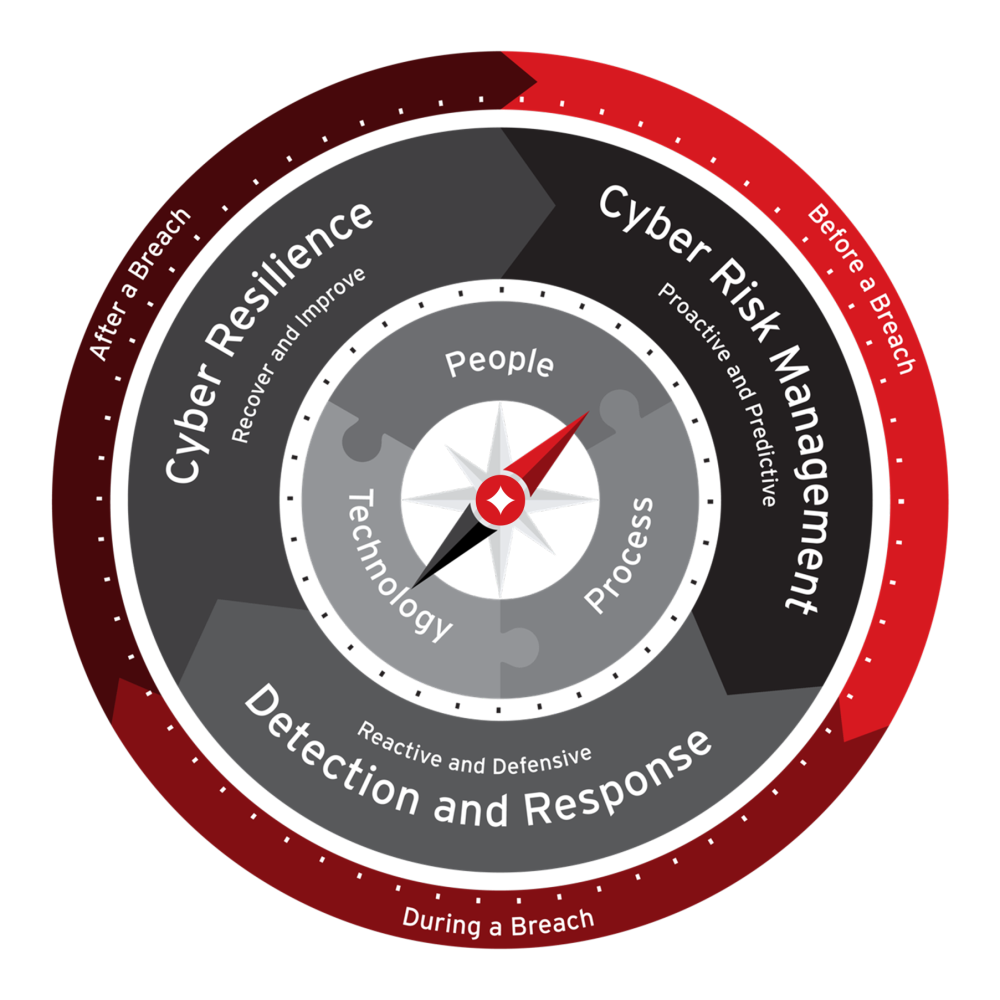
But that left two enormous parts of the problem unaddressed. What happens before the breach, where cyber risk builds silently and decisions are made without understanding the exposure they create? And what happens after the breach, where the real test of an organization is not whether it was hit but whether it learned, adapted, and came back stronger? The Compass was built to name all three domains and force organizations to work in all of them. Not just the one the industry was most comfortable with.
The Cybersecurity Compass organizes the work across three continuous domains: Cyber Risk Management before a breach, Detection and Response during a breach, and Cyber Resilience after a breach.
These are not sequential stages. They are domains you work in simultaneously, each feeding the next, in a cycle that never closes because the environment never stops changing.
Cyber resilience sits in the after-breach domain. But it is not a final destination. It is a return point. Every incident, managed well, produces intelligence that improves how the organization anticipates the next one. Every recovery strengthens the next response. Every post-incident review sharpens the risk model that informs the next set of decisions before the next breach.
This is the cycle that produces the outcome. Not a cyber resilience programme running separately from the business. Cyber resilience as the result of running the full cycle, before, during, and after, with discipline and continuity.
And this is why cyber resilience cannot be built apart from the other domains. An organization with excellent incident response but fragmented proactive cyber risk management will always be fighting the wrong battles at the wrong time. An organization with strong cyber risk management but an untested recovery process will find its gaps at the worst possible moment, during the incident itself.
Cyber resilience is not what you do after the crisis. It is the outcome of everything you did before the crisis, during the crisis, and in every cycle that came before it.
From Treatment to Operationalization
The Cyber Risk Operations Center, the CROC, is where operationalization becomes real. Not a rebranded SOC. A fundamentally different function, proactive and continuous, focused on reducing exposure rather than only responding to incidents.
The SOC asks what happened. The CROC asks what our exposure is right now, how it is changing, and what decisions need to be made today to reduce it. These are different questions. They require different operating models. And they produce different organizational outcomes.
A SOC makes the organization faster at reacting. A CROC makes the organization more confident in acting, before the incident, in the investment decision, in the strategic conversation where digital expansion is being weighed against the exposure it creates.
CyberRiskOps is the discipline that connects cyber risk data to the decisions that depend on it. The Cyber Risk Index, the CRI, gives the organization a live numeric measure of its exposure. It recalculates as the environment changes. It moves the way financial metrics move, reflecting what is actually happening rather than what happened last quarter. Business units can track their cyber risk exposure the way they track their financial exposure, as a live number with real consequences for real decisions.
This matters especially in an agentic AI environment, where new capabilities are deployed faster than traditional governance cycles can evaluate them. CyberRiskOps gives the organization a way to assess exposure continuously, not periodically. It transforms the question from “did we approve this agent?” to “what is our live exposure given how this agent is behaving right now?”
This is what operationalization produces. Not certainty, but the clarity to move under uncertainty. Not a risk-free environment, but an organization that navigates cyber risk better than its competitors.
At the highest levels of maturity, cyber risk stops being a constraint and becomes a source of competitive advantage. Cyber risk data shapes innovation decisions. Confidence in controls supports faster execution. The organization can commit to digital initiatives that competitors hesitate over, because it can see the cyber risk exposure and manage it continuously. Security stops being a defensive cost and becomes an enabler of faster, safer growth.
Cyber Resilience Requires a Strategy, Not Just a Plan
Most organizations confuse having a plan with having a strategy. A plan tells you what to do. A strategy tells you why, where, and how you are positioning yourself to stay in the game over time.
Cybersecurity is not a finite game. There is no final state of “secure.” Threats evolve. Attackers adapt. New attack surfaces appear with every new integration, every business change, every new agent deployed in an agentic workflow. The organizations that treat cybersecurity as a project with a finish line will always be disappointed, because the finish line does not exist.
The goal is not to win once. The goal is to stay in the game, to endure, to adapt, and to improve continuously.
That changes how we need to define strategy:
Cybersecurity strategy is an integrative set of choices that positions your organization on a cyber risk landscape of your choice in a way that sustains cyber resilience over time.
Every word matters here. Choices, not activities. Position, not coverage. Sustains, not achieves. Over time, not at a point in time. This definition connects strategy directly to cyber resilience as an outcome. If cyber resilience is what you are building toward, then strategy is the framework of choices that produces it. Where do we focus? What cyber risks are we willing to accept? What does recovery mean for our specific business? How do we learn faster than threats evolve?
Without this strategic frame, continuous cyber risk management becomes a set of operational activities without direction. You can run the CROC, generate live cyber risk scores, and monitor controls in real time, and still not be building toward cyber resilience, because you have no clarity on what cyber resilience means for your organization specifically.
Strategy is what turns operational discipline into purposeful progress: Tools will not define your strategy. Frameworks will not tell you where to go. Technology alone will not make you resilient. Your ability to make clear, cyber risk-informed choices and remake them as the environment changes is what determines whether continuous cyber risk management produces the outcome you need.
The Outcome That Changes Everything
Let me come back to where this started: True risk management is not about operating in a risk-free environment. It is about creating a resilient organization that can turn uncertainty into a competitive advantage.
In cybersecurity, this means accepting that the goal is not to finish the work. The goal is to stay in the game, to keep playing with more skill and more cyber resilience than the round before. Not eliminating all cyber risk. Not achieving a perfect posture. Sustaining the capacity to operate, absorb, recover, and improve continuously.
This is more true today than it has ever been. Agentic AI is not just a new attack surface. It is a new operating model. Organizations that build cyber resilience around continuous cyber risk management will be able to adopt it with confidence. Organizations that are still chasing a risk-free posture will hesitate, delay, and fall behind, not because the technology is too dangerous, but because they have no reliable way to understand their own cyber risk exposure.
Cyber resilience is not a capability you build and then have. It is an outcome you earn every day through the discipline of managing cyber risk continuously, connecting that work to business decisions, and building an organization that moves with clarity even when the environment is uncertain.
In this environment, cyber resilience is no longer just a defensive capability. It is the outcome of continuous cyber risk management, enabling organizations to operate with confidence even under conditions of uncertainty.
That is what cybersecurity owes the organizations it serves. Not just protection from what has already happened. The ability to grow, decide, and act with clarity through the storm.
For boards and executives, this means changing the question. The question is not: are we secure? That question has no real answer, because security is not a state. The question is: are we managing cyber risk continuously, and is that work producing the cyber resilience our organization needs to operate with confidence? That question has an answer. And the organizations that can answer it honestly are the ones best positioned to lead in the years ahead.
Castro, J. (2024). From Reactive to Proactive: The Critical Need for a Cyber Risk Operations Center (CROC). ResearchGate. https://www.researchgate.net/publication/388194441 DOI:10.13140/RG.2.2.27408.93445/1
Castro, J. (2024). Safely Sailing the Digital Ocean with the Cybersecurity Compass. ResearchGate. https://www.researchgate.net/publication/387410177 DOI:10.13140/RG.2.2.20696.00003
Castro, J. (2024). Cyber Resilience: The Learning Phase of the Cybersecurity Compass Framework. ResearchGate. https://www.researchgate.net/publication/387903363 DOI:10.13140/RG.2.2.11619.67366
Castro, J. (2025). Cyber Risk Should Not Be Treated — It Should Be Operationalized. ResearchGate. https://www.researchgate.net/publication/389991463 DOI:10.13140/RG.2.2.12429.45289
Castro, J. (2025). Cyber RiskOps: Bridging Strategy and Operations in Cybersecurity. ResearchGate. https://www.researchgate.net/publication/388194428 DOI:10.13140/RG.2.2.36216.97282/1
Castro, J. (2025). How a Cyber Risk Index (CRI) Can Be Used as a KPI in Your Cybersecurity Strategy. ResearchGate. https://www.researchgate.net/publication/389001302 DOI:10.13140/RG.2.2.32915.18728
Castro, J. (2025). Cyber Risk Operations Center (CROC) Process and Operational Guide. ResearchGate. https://www.researchgate.net/publication/389350613 DOI:10.13140/RG.2.2.19164.09600
Castro, J. (2025). The Illusion of “Continuous” in Cybersecurity: The Biggest Vulnerability in Frameworks and Regulations. ResearchGate. https://www.researchgate.net/publication/388682749 DOI:10.13140/RG.2.2.10471.15520/1
Castro, J. (2025). Cyber Risk Operational Model (CROM): From Static Risk Mapping to Proactive Cyber Risk Operations. ResearchGate. https://www.researchgate.net/publication/390490235 DOI:10.13140/RG.2.2.15956.92801
Castro, J. (2025). What Is Strategy in Cybersecurity? Rethinking the Way We Lead, Protect and Adapt. ResearchGate. https://www.researchgate.net/publication/393674625 DOI:10.13140/RG.2.2.16703.42409
Castro, J. (2025). Cyber Risk Is the Board’s New Responsibility. Not Just the CISO’s Burden. ResearchGate. https://www.researchgate.net/publication/395135919 DOI:10.13140/RG.2.2.11956.31361
Castro, J. (2025). Every Cyber Risk. Every Signal. Continuous Defense Loop. ResearchGate. https://www.researchgate.net/publication/396885730 DOI:10.13140/RG.2.2.30137.22882/1
Castro, J. (2025). Why Cybersecurity Will Need More Humans, Not Less, in the Age of AI. ResearchGate. https://www.researchgate.net/publication/395524745 DOI:10.13140/RG.2.2.13176.92160
Castro, J. (2026). CyberRiskOps: The Operating Model for Cyber Resilience in the Age of AI. ResearchGate. https://www.researchgate.net/publication/402149983 DOI:10.13140/RG.2.2.27088.37128
Castro, J. (2026). Trust Between Machines: The Missing Layer in the Age of Autonomous AI Agents. ResearchGate. https://www.researchgate.net/publication/400799349 DOI:10.13140/RG.2.2.31121.29287
World Economic Forum. (2024). Unpacking Cyber Resilience. https://www.weforum.org/publications/unpacking-cyber-resilience/
World Economic Forum. (2025). The Cyber Resilience Compass: Journeys Towards Resilience. https://www.weforum.org/publications/the-cyber-resilience-compass-journeys-towards-resilience/
Carse, J. (2011). Finite and Infinite Games. Free Press. https://www.amazon.com/-/es/James-P-Carse-ebook/dp/B004W3FM4A/